
On October 30, we announced that House Numbers, the company I’ve spent the past five years building with my co-founders Jeff and Arthur, was acquired by Dark Matter Technologies (DMT). I’m incredibly proud of what we built and excited for what comes next.
House Numbers built AI software that automated mortgage loan processing. DMT is an industry-leading mortgage software provider for banks, credit unions, and independent mortgage lenders. It’s a subsidiary of Constellation Software (CSI), a Canadian public company that acquires, manages, and builds vertical market software businesses. Our mission at DMT is to help build and scale its AI software division.
From Baseball Cards to Mortgage Software
I’ve been an entrepreneur from the moment I could hustle. I earned my first dollar with an orange juice stand in grade school. In early high school, my dad showed me eBay, and I started selling baseball cards and trading expensive fabrics. I was out-earning my friends who had typical high school jobs, and I was having way more fun. It was my first education in negotiation, operations, price elasticity, and sales.
Through college and law school, I built Your Kicks, a custom hand-painted shoe company. We partnered with local artists on the designs, outsourced the production and painting to China, and sold to retailers around the world. Somehow, we even got Zac Efron wearing our designs.

Then in my 20s, I moved to Silicon Valley to be closer to the startup scene. I retooled my career around technical skills: growth hacking, software engineering, and data analysis. I joined Maven Ventures as Entrepreneur-in-Residence and worked with a handful of early-stage startups.
Then, during COVID, my friend Jeff Levinsohn approached me about starting a mortgage tech company together. His idea was an app to help homeowners track and optimize their home finances. I’d known Jeff for almost a decade, and I’ve always loved the crossroads of finance and tech, so it was a no-brainer. By that winter, we had launched a prototype, raised venture funding, and landed our first customers.
v1: HomeSpring
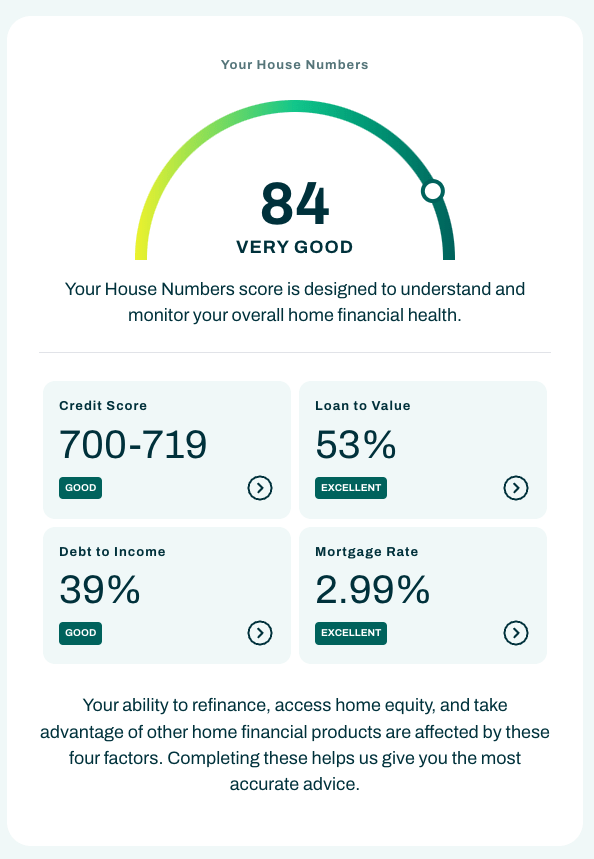
Our first product, HomeSpring, focused on home wealth management. We wanted to help the roughly 50+ million U.S. homeowners with a mortgage manage the finances around their largest asset, their home. HomeSpring let homeowners visualize and track their home value and equity, along with key metrics like loan-to-value (LTV), debt-to-income (DTI), and credit score. With just a few clicks, we could gather enough financial information to tell whether someone was in the best mortgage product for their home, and recommend how to fix it if they weren’t. The experience was smooth, customers loved seeing how much money they were saving, and interest rates were dropping by the day. Things were going great.
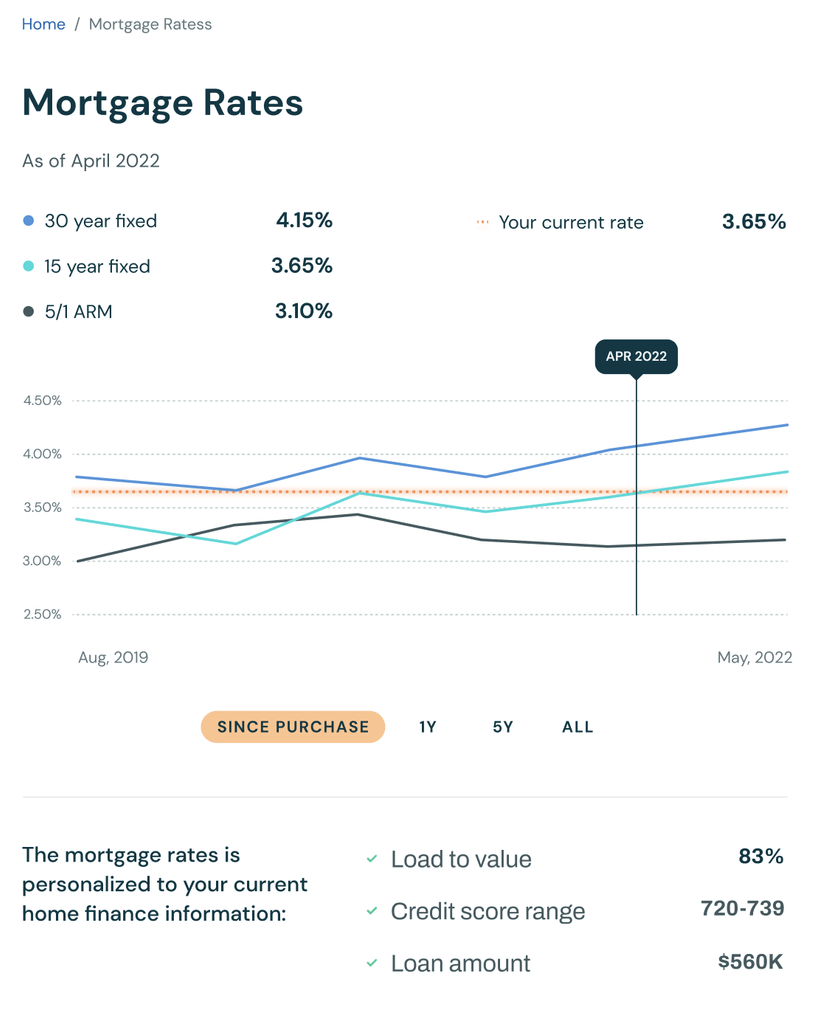
Then the macro winds changed, quickly and drastically. After rates hit all-time lows, the market took a sharp turn. Rates shot up and refinancing collapsed. Instead of optimizing their mortgages, homeowners hung on to their super low-rate mortgage and braced for the wild ride of rising borrowing costs and an affordability squeeze on their household budgets. Our market shrank almost overnight.
v2: Debt Optimization
So we pivoted to an idea built for the higher-rate environment. We spoke with many homeowners carrying high-interest debt, like credit cards and personal loans. At high interest rates, that debt becomes an ever-growing snowball you can never get ahead of.
We built tools to help homeowners convert that toxic high-interest debt to more manageable low-interest debt. In other words, they would pay off their credit card balances or personal loans using their home equity. In that high-rate environment, it was a fantastic idea.
At first, we worried the product would encourage homeowners to spend beyond their means. Our customer research showed the opposite: our users were average middle-class Americans in a financial pinch. There was Daniel in Texas, who took out a $25,000 personal loan to help pay for his daughter’s college. And there were Ishaan and Aditi in Florida, who put $45,000 of home renovation costs on their credit cards just to get the project moving. Both had stable jobs, both understood their debt and income, and both needed a fast way to move large balances onto a more affordable product. We helped both consolidate those balances into home equity lines of credit (HELOCs).
But while our customers loved us and referred us to their neighbors, the math wasn’t mathing (ie: the unit economics were ugly) — we were profitable only when everything went right: max commission, at least $50K drawn, no rescissions, no hidden expenses. Miss on any one of those, and we lost money on the conversion. (For those curious: broker commissions run about 1–3%. It cost us about $850 to acquire a borrower so while some loans were barely profitable, most were underwater or broke even).
So, as startups do, we pivoted once again, this time to B2B.
v3: House Numbers
Running our first two businesses, we lost customers during the processing step of their refinance. A homeowner would agree to start the process but never make it to the finish line. Sometimes they lost interest. But a few times, the processors we hired dropped the ball: they forgot to collect documents, didn’t answer borrowers’ calls, or moved too slowly.
To understand why this happens, one must understand that getting a mortgage is a financial colonoscopy. The lender conditions the loan on dozens of documents: tax returns, pay stubs, bank statements, 1099s and W-2s, letters from employers. The list goes on. The process is arduous and time-consuming, and borrowers hate it. Brokers hate it too, because it kills deals.
We knew we could do better. Loan origination systems already did the plain-vanilla work of getting a borrower their loan, but once ChatGPT hit the market, everything changed. As a nimble early-stage startup, we saw the writing on the wall. AI was going to revolutionize mortgages, and the lenders, brokers, and software providers that adopted it first and most aggressively would win. We wanted to be at the bleeding edge of that shift, so we put all of our resources into building AI tooling on top of existing mortgage software.
Once we made that pivot, business took off like wildfire. We were processing so many loans that I was regularly working weekends and clocking 70+ hour weeks. I was always on the phone while multitasking my ass off — emails to partners while answering employee’s Slack messages while scrolling LinkedIn applicants, etc. It was a lot. I missed important events, weddings, and life milestones of people I love. But we knew we had something, and we had to scale it, fast. We grew to 45+ people in the U.S. and abroad.
We loved what we were building, and so did the market. As word got out, we started fielding interest from lenders and software providers who saw our technology as a cornerstone of their future software stack. But the more conversations we had, the clearer it became where House Numbers belonged. That is, we wanted to partner with a company with a strong vision and large scale.
Enter Dark Matter Technology. Their team already believed what we believed, that AI will reshape mortgage lending from the inside out. They weren’t just talking about it, either; they were already putting AI agents and an AI assistant directly inside Empower (the backbone for some of the largest lenders in the country). We had built AI that changes how a loan gets processed. DMT could put it in front of thousands of lenders and customers.
What I’m Taking With Me
This was a great outcome, and I’d do it all again. But five years and three products teach you a few things:
- I like B2B much more than B2C. Our consumer products delighted users but fought brutal acquisition costs. Selling to businesses lets us solve one painful problem for many customers at once.
- AI is the future, so run toward it. The companies that adopt it first and most aggressively will win. We went all in early, and it changed everything for us.
- Respect the macro. You can’t control interest rates. You can’t control large leaps in innovation (AI, smart phones, the internet, etc). All you can do is move fast enough to adapt when they change.
The Future
So here we are. We’re now integrating all of our software features and AI products into DMT’s Empower LOS, the backbone for some of the largest lenders in the country. DMT works with the country’s largest lenders and is innovating faster than any of their competition. The scale is impressive and exciting. The AI workflows we built will now reach lenders across the country, and through them, countless borrowers who deserve a mortgage process that doesn’t feel like a financial colonoscopy.
Thank You
The people who’ve helped me over the years know who they are, but I’d especially like to call out a few who’ve been mentors and good listeners.
First, my two phenomenal co-founders, Jeff and Arthur, and our amazing team, including our early engineering hires, Andre and Marcos. I’m also grateful to our early mortgage experts, Phaedra and Brooke, and our back-office AI ninjas, Karla and Regina. We could not have built this company without your expertise and experience.
To our early backers and believers: Robert Ravanshenas (along with Jim and Sara) at Maven Ventures, and Raanan at Resolute. You invested in us early and advised us through the entire journey. I’m forever grateful for your industry insights, your wisdom, and for always pushing me to do better.
To my friends who helped me work through the “I don’t know what I don’t know” problems: whether the days were good or bad, you were always there when I texted or called. I hope I get the chance to return the favor one day.
To my always optimistic and smiling wife, Alexandra: you are my rock and my sounding board, and life just isn’t the same when you’re not near.
And finally, to my always-patient parents, my greatest cheerleaders from my first business to my last. You’ve always believed in me, supported me, and guided me through life. I stand on the shoulders of giants, and I’m humbled by the sacrifices you made to get me here. I hope one day to be even a tenth of the parent you are.